

2023 was a challenging year for me, both financially and personally.
The stock market was still recovering from the major decline of 2022, while I was simultaneously going through a separation and divorce that was eventually finalized in April 2024. I am publishing this 2023 financial summary retroactively. Some of the financial tracking became more difficult as the year progressed.
In April 2023, I flew from Portugal to Australia. At the time, my wife and I were both planning to move to Australia, but our plans began to unravel. Ultimately, she remained in Portugal while I continued living in Australia.
Because we were still married for most of 2023, the spending figures in this report require a little explanation. Our spending is based on our combined expenses through July 4, 2023 and then extrapolated through the remainder of the year. The net worth figures, however, represent my assets only.
Investment Performance
Despite everything else going on, 2023 was an excellent year for the stock market.
The U.S. stock market, as measured by VTI (Vanguard Total U.S. Stock Market ETF), returned 26.03% in 2023, including both price appreciation and dividends, according to Vanguard. The FinanceCharts data shown in the chart below reports a slightly different figure of 26.05%, based on pricing through December 29, 2023.
This was a dramatic turnaround from 2022, when the U.S. stock market fell approximately 19.5%. The market reached its 2022 low in October before beginning a gradual recovery that continued throughout 2023.
For someone living primarily off an investment portfolio, that recovery was particularly important.
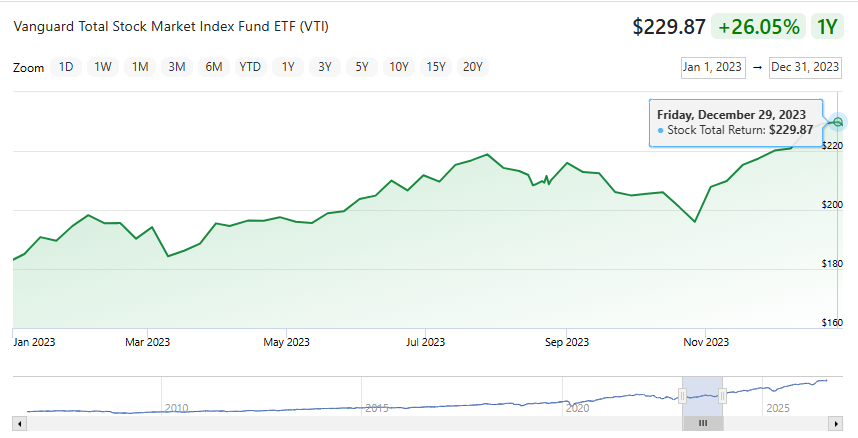
* Chart is from https://www.financecharts.com/etfs/VTI/performance
Net Worth
I use Empower Personal Dashboard to track my net worth, and I highly recommend it as a powerful free tool for monitoring your finances.
One limitation is that Empower only tracks my U.S. financial accounts, so I manually add my foreign accounts using Excel.
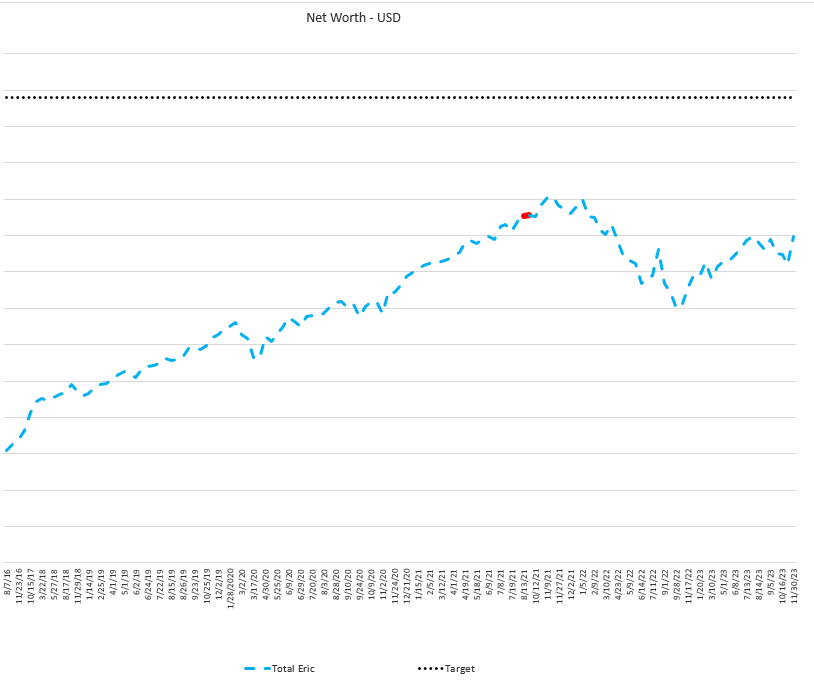
The net worth figures and chart below represent my financial assets only and do not include any assets belonging to my ex-wife.
I also established a new net worth target, represented by the dotted line on the chart. This is the level I wanted to reach to support the annual spending budget that I considered comfortable for my retirement. At the same time, I try to keep my actual spending at or below a 3.2% withdrawal rate based on my current net worth in any given year.
The first red dot on the chart represents my personal net worth when I retired in September 2021. At the time, my retirement decision was based on our combined financial position as a married couple, rather than solely on my individual assets. The figures shown here, however, have been adjusted to reflect only my own finances.
My 3.2% Safe Withdrawal Rate is based on historical market data going back to 1871, including extremely difficult periods such as the Great Depression. I use this historical analysis as a guide for determining how much I can reasonably spend while maintaining a high probability of sustaining a long-term retirement.
For more details on my methodology and how I determined my retirement target, see my article How Much Is Enough for Early Retirement.
Asset Allocation
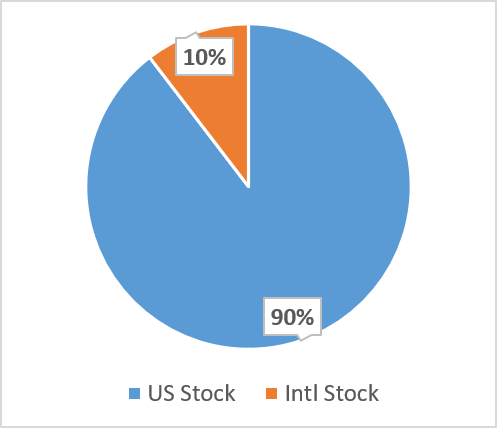
My ex-wife's assets were largely concentrated in real estate, while my assets were primarily invested in equities, with the vast majority in U.S. stocks.
The domestic stock portion of my portfolio was primarily invested in VTI, which tracks the total U.S. stock market. My international stock allocation was primarily invested in VXUS, which tracks the total stock market outside the United States.
I use broad-market index funds because they provide extensive diversification at very low expense ratios. At the time, VTI had an expense ratio of just 0.03%, while VXUS was 0.08%.
My long-term goal has generally been to maintain a very high allocation—roughly 75–100%—to VTI. Based on my historical analysis of early-retirement withdrawal rates and portfolio returns, I believe a high equity allocation gives me the best chance of achieving the long-term returns necessary to support an extended retirement.
Net Worth Check - Below target but moving in a positive direction
Asset Allocation - OK
Budget
Because my net worth was below my target, I needed to be relatively careful with spending.
Unfortunately, 2023 was an unusual year from a budgeting perspective. My ex-wife was living in Portugal while I was living in Australia, which effectively meant that we were maintaining two households. Portugal is generally less expensive than Australia, but having expenses in two countries still made the situation more complicated.
I use Empower Personal Dashboard to track my budget because it allows me to see credit card spending and bank account withdrawals in one place. I can also download the data into Excel for further analysis. The downside is that I still have to manually incorporate spending from overseas accounts.
Our combined spending through July 4, 2023 is shown below.

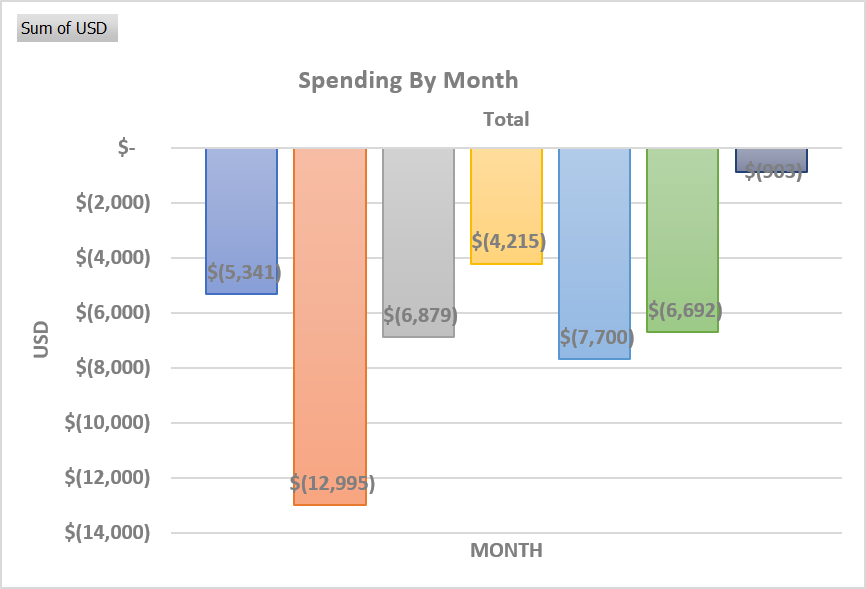
The spike in February was mostly due to hardware and general merchandise for the Portugal Townhouse.
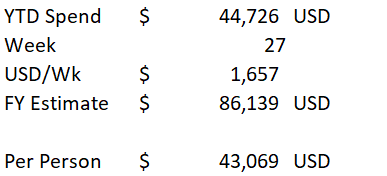
Year to date as of July 4, 2023 we had spent $44,726 USD and were on track to spend about $86k USD by the end of the year. That was well above my personal Safe Withdrawal Rate (SWR) based on only my own Net Worth. However, it was within the SWR for our combined Net Worth. If I divide by two to very roughly estimate a per person full year spend amount I arrive at $43k USD which was within my 3.2% safe withdrawal rate based on my current Net Worth at the time.
A breakdown of our spending categories is shown below:
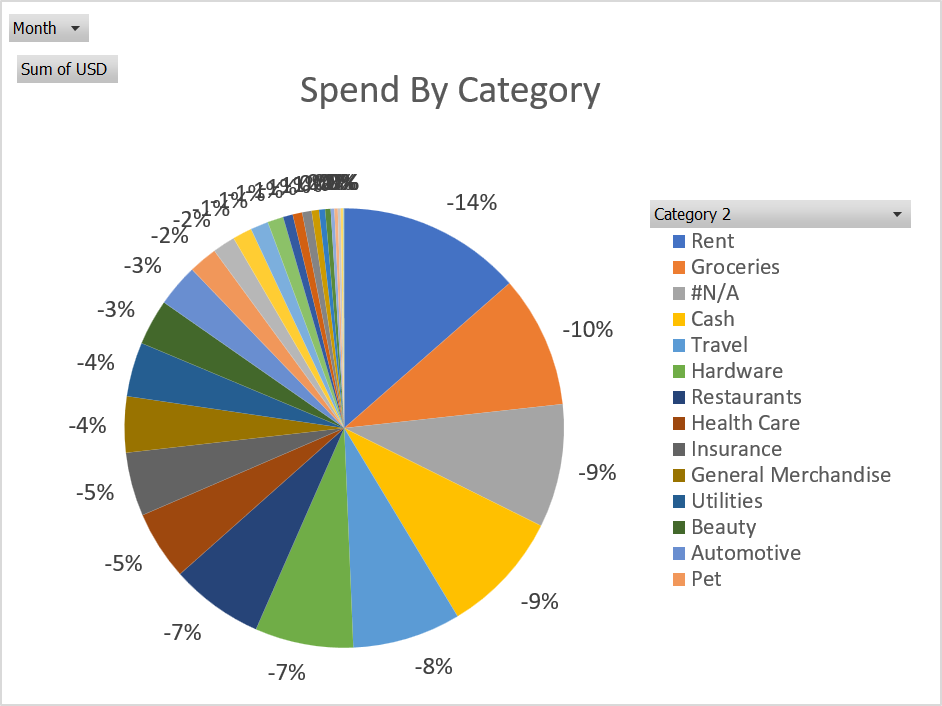
Rent represented only 14% of our total spending during this period because my ex-wife was staying at the Portugal townhouse and I stayed with a friend in Australia for part of the year. Under more normal circumstances, housing tends to represent closer to 35% of my total spending.
Summary
2023 was an unusual year in almost every respect.
Personally, it was one of the most difficult years of my life. I was dealing with a separation, an impending divorce, an international move that didn't work out as planned, and the logistical challenges of maintaining two households in two different countries.
From a market perspective, however, the year turned out considerably better.
The stock market recovered strongly, with VTI gaining approximately 26% for the year. Although our spending was higher than I would have preferred, our combined withdrawals remained below our combined 3.2% SWR target. When I roughly allocated the spending between us on a per-person basis, my spending also remained around or below my 3.2% target based on my individual net worth.
So, despite the personal turmoil, I ended the year in a reasonable position.
Looking back, 2023 was really a transition year. A lot of things that I thought were going to happen—moving to Australia together, maintaining our marriage, and continuing the life we had planned—ultimately didn't happen.
Life rarely follows the plan.
Sometimes all you can do is adapt, keep moving forward, and try to make the best decisions you can with the circumstances you're given.
That was 2023 for me.