

2024 was an unusual year for me financially.
The US stock market performed extremely well, but my own financial situation changed dramatically for another reason: my divorce was finalized on April 15, 2024. As a result, this is the first annual financial update where I am tracking my finances entirely on my own rather than as part of a joint or partially combined financial situation.
I previously skipped a few of my regular financial checkpoint reviews, so I am going back and publishing some of the analysis that I never released at the time. This update follows roughly the same format as my previous financial checkpoints, covering net worth, asset allocation, spending, and my withdrawal rate.
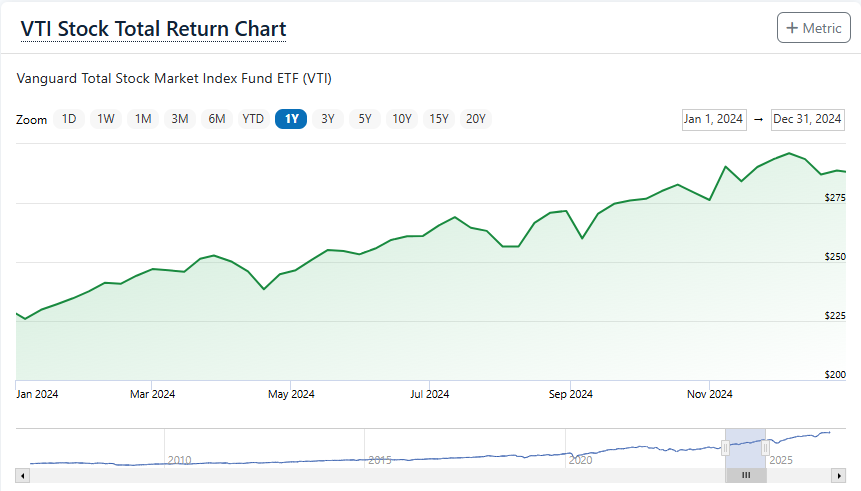
For some perspective, the US stock market, as measured by VTI (Vanguard Total US Stock Market Index) performed quite well in 2024 returning 23.75% including stock price appreciation and dividends.
Net Worth
I use Empower Personal Dashboard to track my net worth, and I highly recommend it as a free tool for anyone who wants to monitor their finances. Unfortunately, it only tracks my US accounts, so I add my foreign accounts separately using Excel.
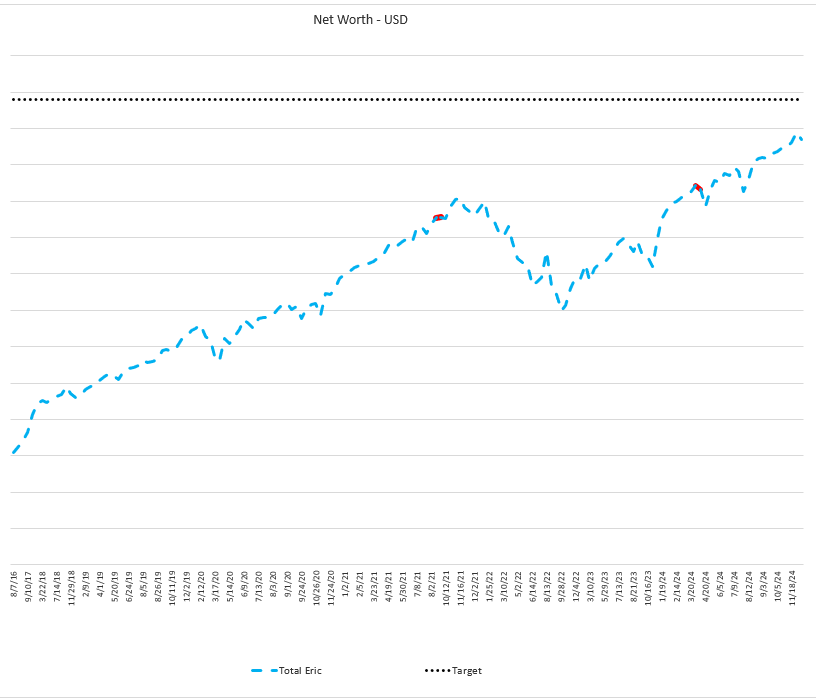
The dotted line in the chart represents my new net worth target following my divorce. This is the portfolio level I would ideally like to maintain because it gives me the annual spending budget that I consider comfortable.
I limit my spending to a 3.2% withdrawal-rate target, calculated using my actual portfolio value in each year.
The first red dot represents my personal net worth when I retired in September 2021. The second red dot represents my net worth when my divorce was finalized in April 2024.
When I originally retired, my decision was based on our joint financial situation. Following the divorce, however, the financial picture changed substantially because these figures now represent my finances alone.
Fortunately, the strong performance of the stock market in 2024 helped my portfolio recover significantly, and my net worth is moving closer to my new target.
The 3.2% Safe Withdrawal rate was based on historical data going back to 1871 which includes periods such as the Great Depression. For more details on this, please see the article “How Much Is Enough for Early Retirement".
Asset Allocation
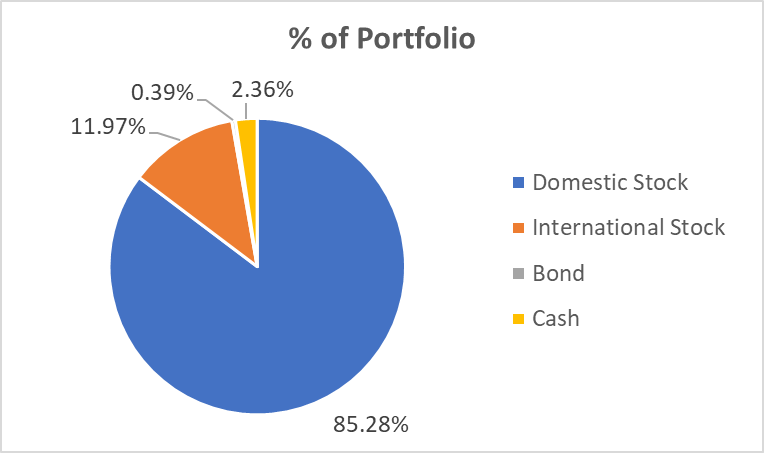
I remain heavily weighted toward equities.
The majority of my US stock allocation is invested in VTI which tracks the Total US Stock Market. My international allocation is primarily invested in VXUS which tracks the total ex-US Stock Market.
I also have a portion of my international allocation invested in IDV an international high-dividend ETF.
I use index funds because they provide broad diversification while keeping expenses relatively low:
- VTI: 0.03% expense ratio
- VXUS: 0.08%
- IDV: 0.51%
I am considering reducing or eliminating my position in IDV and simplifying the portfolio to primarily VTI and VXUS. There are two main reasons for this.
First, IDV has historically underperformed vs. VXUS over long periods.
Second, its expense ratio is substantially higher.
Overall, I continue to want a high allocation to equities, with approximately (75-100%) of my portfolio in VTI.
That is a much more aggressive allocation than many traditional retirement portfolios, but my retirement is potentially 40+ years long. Based on my historical analysis in How Much Is Enough for Early Retirement, I believe maintaining substantial exposure to US equities gives me the long-term growth potential I need.
Net Worth Check - OK
Asset Allocation - OK
Budget & Spending
Australia is not a low cost or low tax location so, keeping my Budget in line while living in the Northern Beaches of Sydney is a bit challenging. However, I have been able to contain my costs fairly well.
I use the Empower Personal Dashboard to track my spending because it allows me to see credit-card transactions and bank-account withdrawals in one place. I can also download the data into Excel for additional analysis. The limitation is that I have to manually add spending from my overseas accounts.
The chart below shows my spending by month.

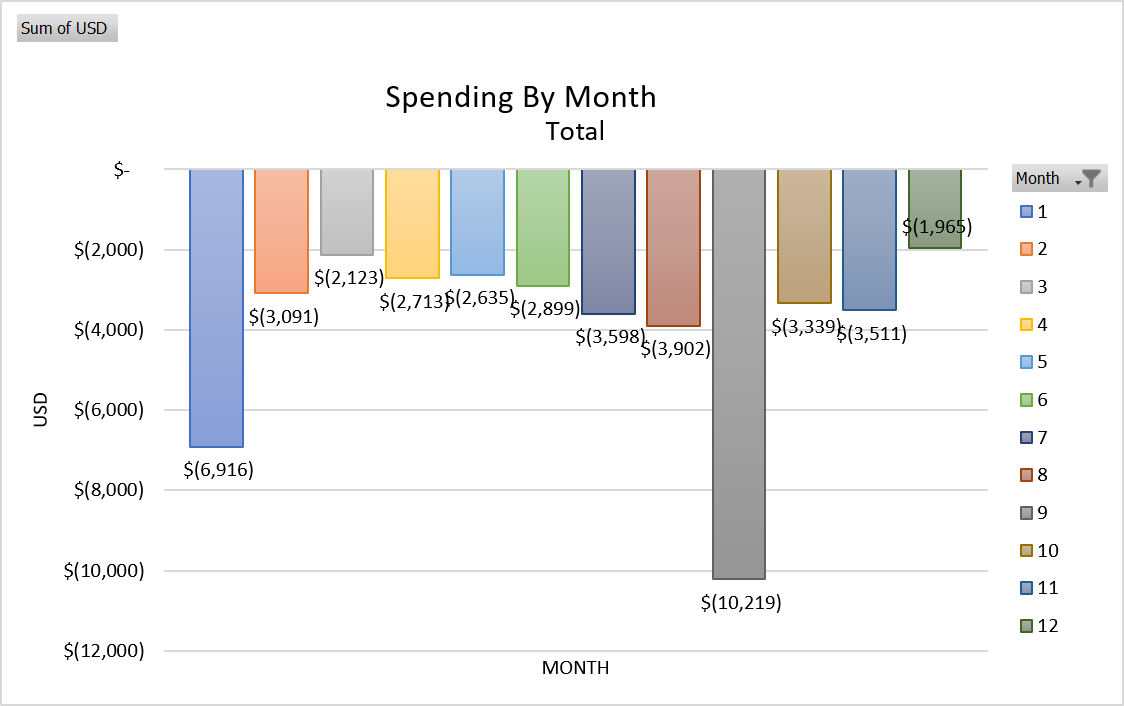
Overall, I did a fairly good job of keeping my spending under control, although there were two significant spikes: January and September.
January was unusually high primarily because of legal expenses associated with my divorce, along with some US tax payments.
September was another expensive month because of Australian and Portuguese taxes.
As of December 28, I had spent $46,910 USD for the year and was on track to spend approximately $48,000 USD ($72,000 AUD) by the end of 2024.
That puts my spending comfortably within my 3.2% withdrawal-rate target.

A breakdown of my spending categories is shown below:
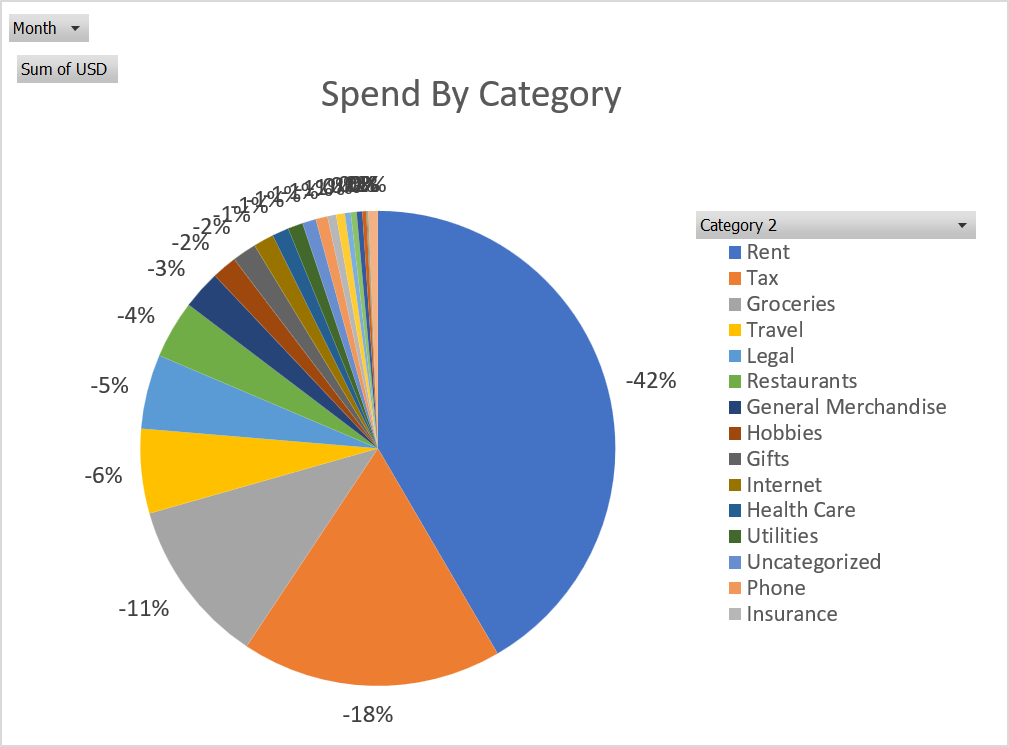
Rent Is the Biggest Expense
Rent is consistently one of the largest components of my budget, generally accounting for approximately 35–42% of my total annual spending.
For anyone trying to estimate their own early-retirement budget, this is one of the most useful rules of thumb I have found from my own experience:
Start with your annual rent and assume your total spending will be roughly 2.5–3 times that amount.
Obviously, everyone's circumstances are different, but housing costs tend to dominate the budget. Once your rent or mortgage is established, many of the other discretionary expenses are easier to control.
Taxes vs. Healthcare
My taxes were relatively high this year, but one interesting offset is that my healthcare costs remained quite low.
This is one of the trade-offs of living in Australia.
Australia has a public healthcare system, and as a Permanent Resident I am eligible for Medicare. Healthcare isn't completely free—bulk billing has become less common and there are still out-of-pocket costs—but Medicare covers a substantial portion of many healthcare expenses.
I have not purchased private health insurance this year.
I may consider doing so in the future, particularly because private insurance can provide access to private hospitals and potentially greater choice if I ever require major medical treatment.
For now, however, my relatively low healthcare costs are one of the few financial advantages I get from living in Australia.
Summary
Overall, 2024 was a pretty good financial year despite being an unusually complicated personal year.
The stock market performed extremely well, which helped my net worth recover toward my new post-divorce target.
At the same time, I managed to keep my spending under control despite living in one of Australia's more expensive areas and dealing with significant legal and tax expenses.
Most importantly, my withdrawals remained well below my 3.2% withdrawal-rate target, which gives me confidence that my portfolio remains on track to support my early retirement.
Of course, I don't expect every year to look like 2024. Markets will eventually decline, and my net worth will almost certainly experience some significant drops along the way.
That's why I focus less on whether my portfolio is going up every year and more on whether my overall financial plan remains sustainable through good markets and bad.
For now, I'm happy with where things stand.
I've managed to build a financial position that gives me the freedom to spend my time traveling, exploring, exercising, and figuring out what I want the next chapter of my life to look like.
Ultimately, it's not about having the biggest portfolio. It's about having enough money that your money no longer dictates how you live your life.
How are your investments and spending holding up? I'd love to hear your thoughts, experiences, or any tips you've learned along the way.