
Five years ago I stepped off a cliff I had been studying for years.
I was forty-five. Behind me lay more than two decades of climbing the ladders of large global corporations, the slow accumulation of titles and income that eventually placed me in a senior leadership role. I was proud of the work. I actually loved the job. I simply reached a point where a quiet question kept repeating and my spreadsheet analysis was no longer shutting it down:
What if I stopped?
So, in September 2021 I did just that. A few days later I stood in Portimão, Portugal, with a suitcase, a small collection of sporting gear, and the sudden, almost physical sensation of time returned to me. I had no map for what followed, only the knowledge that the portfolio was large enough, the withdrawal rate conservative enough, and the decision irreversible enough that the only remaining task was to walk forward.
What I did not know then was that the next five years would contain a global inflation shock, the sharpest stock-market decline in recent memory, an enormous bull market, a European property purchase, a divorce, an international relocation, a return to Australia, occasional consulting, and the complete rebuilding of a life. Looking back now, I can finally answer the question I could not answer on that September day:
Did early retirement work?
Yes (at least so far)
But not in the shape I had drawn.
The Beginning of the Road
When I left, I believed the hardest part was finished. I had run the numbers. I had written the article How Much Is Enough for Early Retirement? and concluded that a 3.25–3.5 % withdrawal rate was safer than the traditional 4 % for a man of forty-five facing potentially six decades of life. The Shiller CAPE stood near 38—more than twice its long-term average—and that fact sat in my mind like a stone. I built the plan conservatively and then stepped into it.
The market, of course, has no interest in plans.
September 2021 was the crest of a long recovery. Interest rates were near zero. Asset prices were high. I was not retiring to optimise returns; I was retiring to reclaim the hours. We sold most of what we owned, kept the snowboards, surf boards, and the climbing gear, and flew to Portugal. The early months were exactly what the dream had promised: surfing, climbing, running, snorkeling, the slow discovery of what a day feels like when no one owns it but you. I documented the first hundred days as if I were conducting an experiment on myself. I wanted to know what freedom tasted like when the experiment was no longer theoretical.
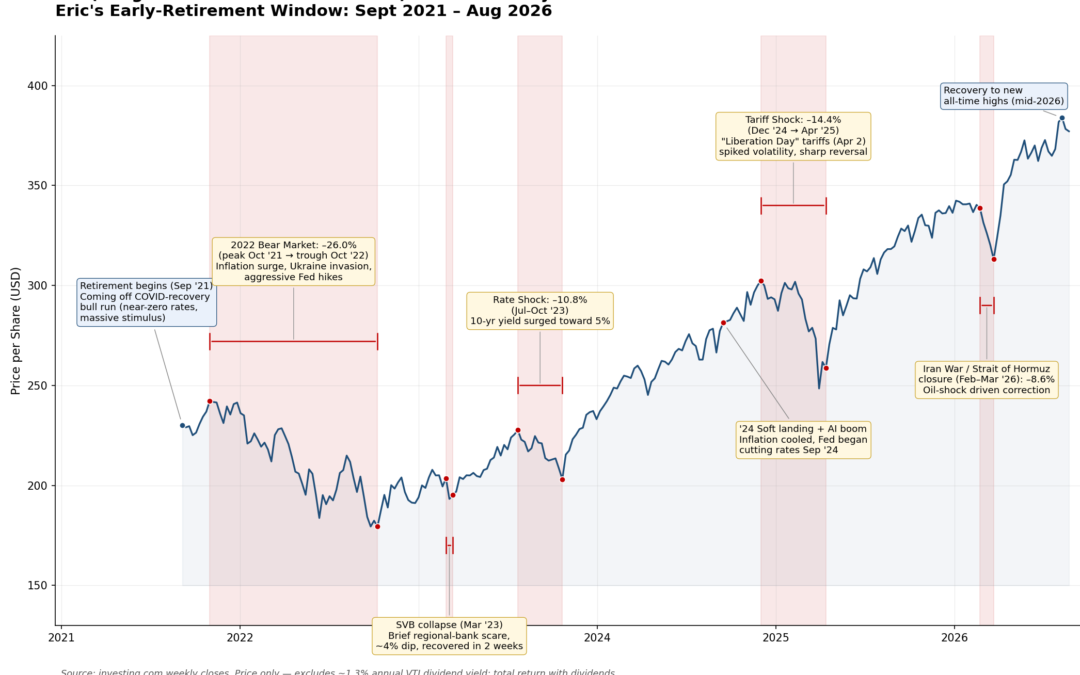
VTI (Vanguard Total US Stock Market Index)
2022: The First Storm
Then the weather changed.
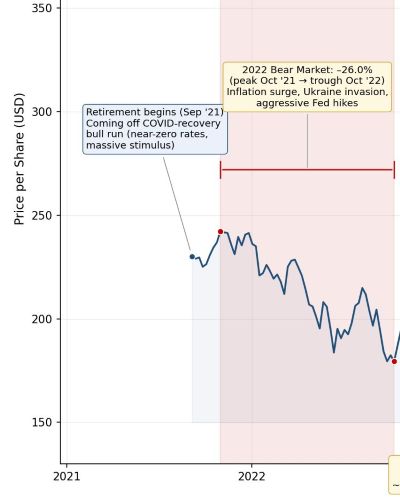
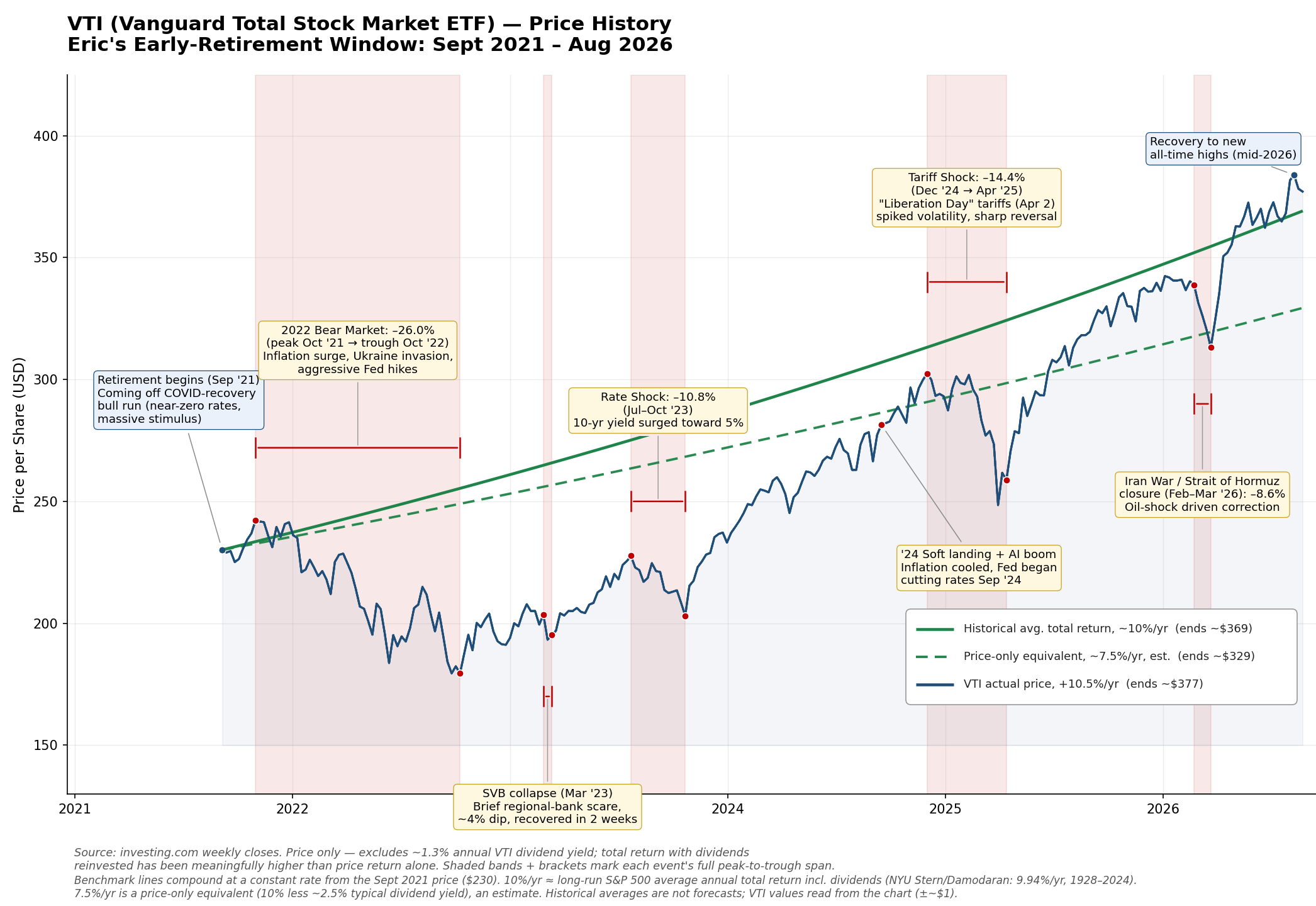
Inflation rose like a sudden wind. Russia invaded Ukraine. Energy prices surged. The Federal Reserve began its aggressive climb. From January through mid-October, VTI—the broad U.S. equity fund that formed the backbone of my portfolio—fell roughly 26 %. I had been retired for little more than a year and my portfolio was down by over $600,000 USD! The theoretical risk of sequence-of-returns had become a living thing sitting at the kitchen table each morning.
When you are still working, a twenty-five-percent decline is unpleasant. When the same portfolio is the river that feeds your life, every withdrawal feels different. Bonds offered no shelter; they fell as rates rose. It was the first true test of the plan.
Yet I did not stop traveling. Spain, France, Greece, Madeira. The ocean still existed. The mountains still existed. We even bought a townhouse in Portugal for €285,000—plus the inevitable cascade of taxes, legal fees, and renovations that turned the purchase into its own small epic of bureaucracy and surprise. I wrote about it under the title The Dramas and Pitfalls of Buying Investment Property in Portugal. The title was accurate.
2023: Recovery Outside, Fracture Within
By 2023 the markets began to heal. Inflation cooled. Technology stocks, lifted by the sudden visibility of artificial intelligence, rose dramatically. My portfolio recovered. My marriage did not.
In January we separated. The financial projections built for “us” no longer applied. Life, I learned then, does not consult the spreadsheet. Divorce, illness, a change of country, a change of heart—none of these appear in the financial simulations. The real gift of financial independence is not the guarantee that the plan will hold; it is the capacity to rewrite the plan when the world refuses to cooperate.
I returned to Australia. Sydney’s Northern Beaches had already claimed a piece of me years earlier, during a corporate relocation. Manly, Shelley Beach, the Blue Mountains—these places felt like old friends waiting with open doors. I moved back and began, slowly, to build something new.
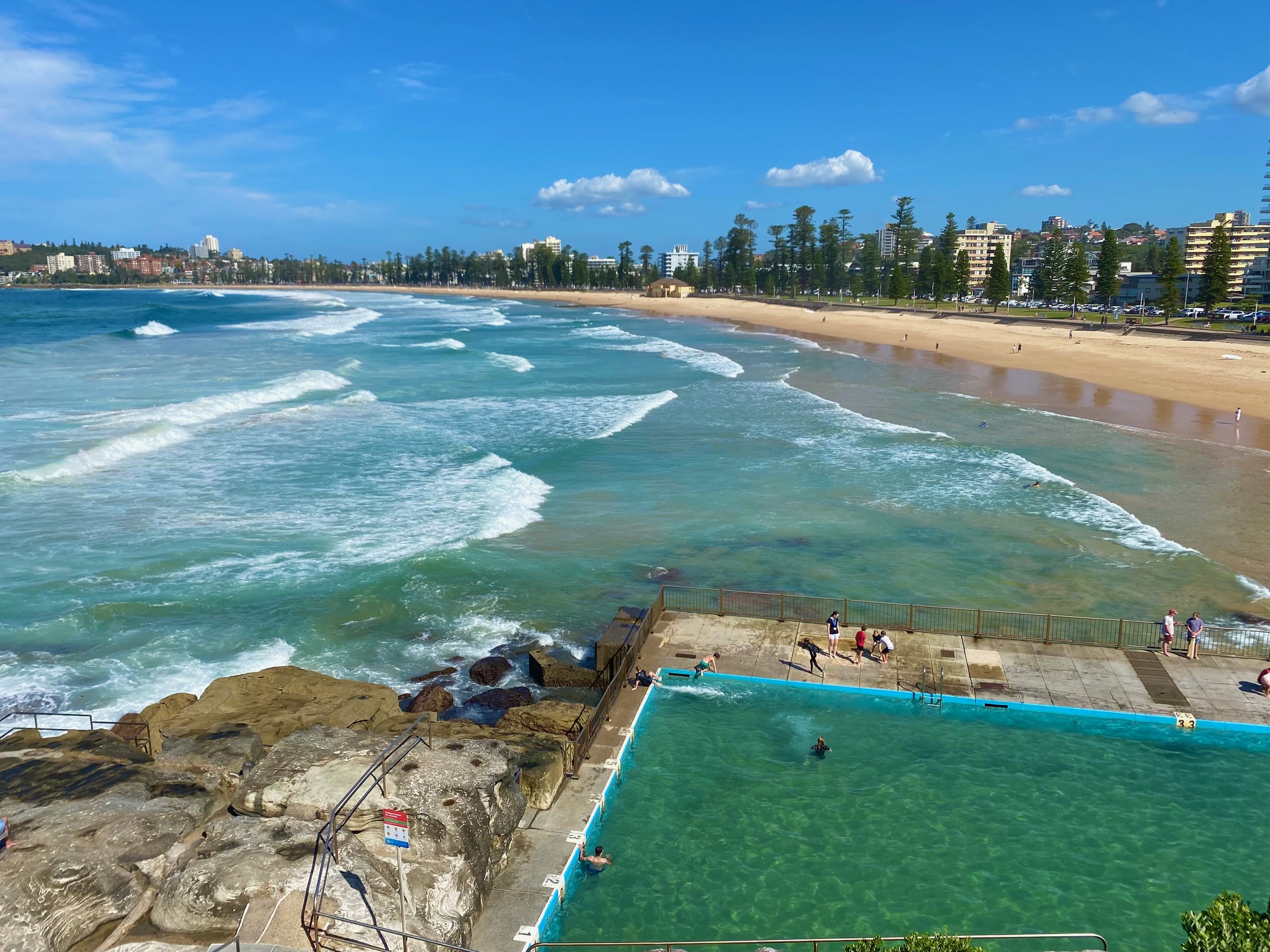
Manly, NSW, Australia
2024–2025: A New Landscape
The divorce was finalised on 15 April 2024. It was costly in every sense. Yet the larger lesson held: the goal is not a life that never deviates from the original model. The goal is resilience enough to change direction without catastrophe.
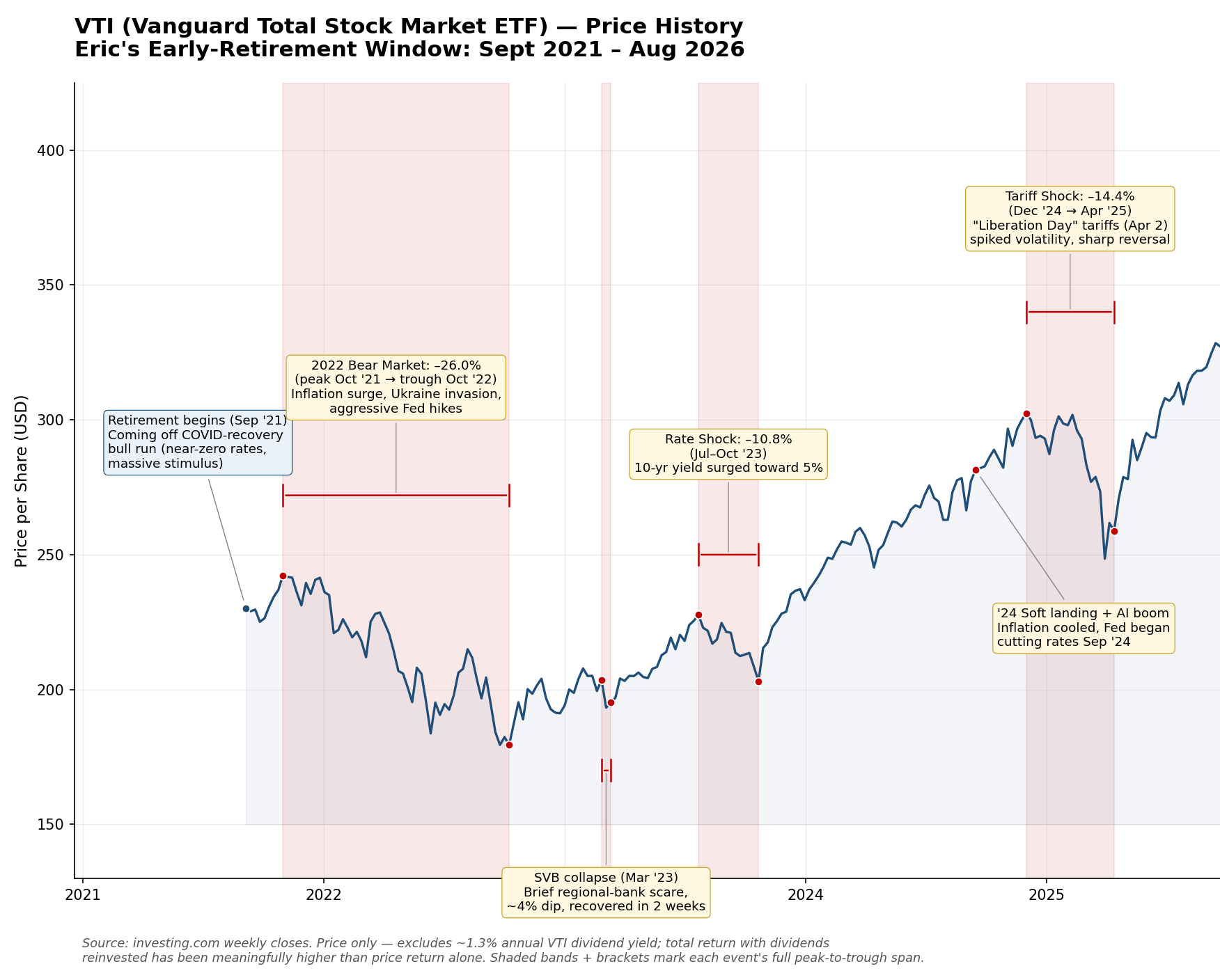
While my personal geography rearranged itself, the markets continued their own story. 2024 brought an interest rate shock driving a drop of 10.8% but then resolving into overall gains for the year of roughly 25%.
Interest rates began to fall. The feared recession never arrived. Early 2025 delivered another scare—sweeping tariff announcements, sudden talk of stagflation, and a sharp, steep plunge of 14.4%. Then the recovery came again, swift and almost casual. By the end of 2025 the index had posted another strong year.
I had walked through high valuations, a bruising bear market, a powerful recovery, a bull market, and a brief tariff shock—all within five years. The path was volatile. The plan endured.
Five Years On
Today I live in a small rented place near the beach in Manly. I surf. I snorkel. I climb. I play beach volleyball. I travel through Australia and New Zealand and farther when the wind is right. I also work—occasionally, by choice. Consulting projects, experiments with technology, the ongoing writing of this journal. The difference is simple and profound: I no longer need a traditional career to keep the lights on. I can choose.
My net worth is sufficient to support annual spending of $100,000 USD at a 3.2 % withdrawal rate. The portfolio stays simple: 85–95 % in VTI, the rest in bonds and non-U.S. equities. Actual spending has usually been lower—$47,365 in 2024, $67,741 in 2025. Consulting income has added a modest buffer. Retirement, I have discovered, need not be binary. There is a wide middle country between full-time employment and permanent idleness.
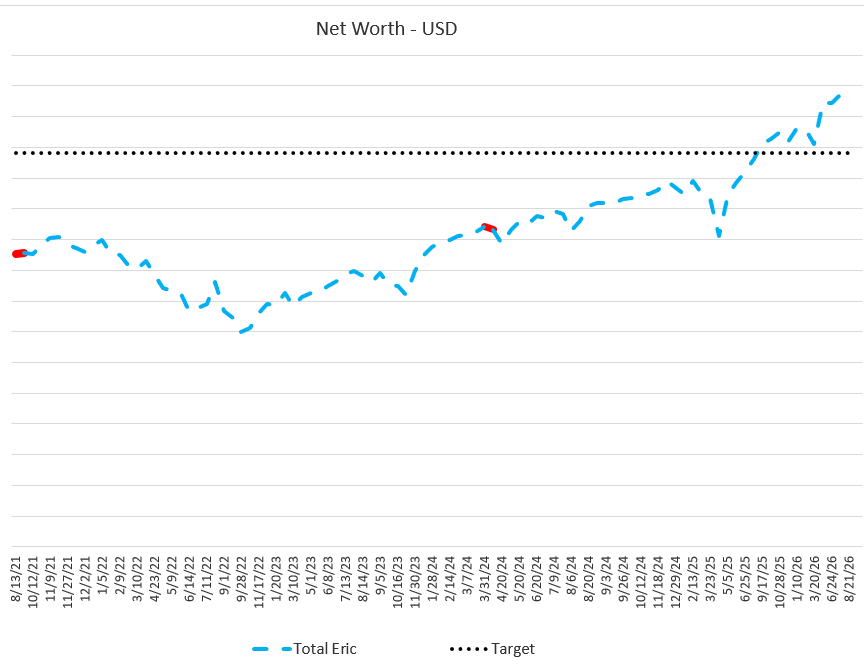
The first red dot is my retirement date in September 2021. The second red dot is when my divorce was finalized on April 15, 2024. The Target dashed line represents where I want my net worth to be to support my desired budget. Keep in mind when I retired, I was married and our joint net worth was significantly higher than mine alone.
Luck and Intention
Was I lucky? The chart below shows the price performance of VTI during my retirement window so far. Up until 2025, you can see that the price of VTI (the blue line) was significantly below the historical market price performance (the dashed green line). So for the first 3 years of my early retirement, the market underperformed the historical trend. Thankfully, in 2025 and 2026 it began to pull ahead and at the current writing is above the historical trend line.
Who knows where it will go from here but having weathered several storms so far, I feel confident I will manage. I kept costs low. I diversified. I avoided leverage. I set and abided by a conservative withdrawal rate. And when the market fell hard, I maintained the course.
What Held and What Did Not
Comfort is a mirage that always demands one more year, one more promotion, one more million. At some point the value of time must be weighed against the value of further accumulation.
I used a conservative withdrawal rate. Sequence risk is real; the margin of safety proved useful.
I kept the portfolio simple. Broad index funds are boring. Boring is a virtue.
I preserved the option to earn. Consulting and part time work are not a return to the old life; they are just another tool in the kit.
And I actually used the freedom. Portugal, the coasts of Europe, the oceans and mountains of Australia and New Zealand, the countless mornings in the water or on the beach — these are the reasons the leap was taken.
What I underestimated was the scale of personal change. Markets, inflation, withdrawal rates—these I modelled carefully. The possibility that an entire life could rearrange itself I modelled far less. Financial independence grants flexibility; it does not grant immunity.
Work supplies structure, identity, companionship, and a daily sense of accomplishment. Remove it all at once and the empty space must be filled with intention. Retirement is not simply the end of work. It is the beginning of many questions: What do I want to do with my time? Who do I want to be? What do I want to learn? What brings me joy? What types of challenges and adventures make me feel alive? How can I build a community that makes my life more fulfilling? Where do I most enjoy living? Do I want to work on something that is fun for me or that I find rewarding? Should I create/build something meaningful?
The Evidence
Five years ago I had a spreadsheet that said I could retire. Today I have five years of lived evidence. The evidence is not that everything unfolded according to plan. It is that when life went dramatically off-plan, the financial foundation was strong enough to allow a change of direction.
That capacity, more than any particular net-worth number, may be the true meaning of early retirement.
I do not know what the next five years will bring. I do not know the path of markets, the shape of future work, the next country, or the next unexpected turn. I no longer need to know. I only need enough freedom to meet whatever arrives.
Five years ago I left a career and took the first step of a journey I knew would likely be uncertain, challenging, exciting, and scary.
The adventure continues!
Five years ago I took a leap into the unknown. The Sanguine Sojourner is, in many ways, the journal of what happened next.
Related articles:
- How Much Is Enough for Early Retirement? — my original September 2021 analysis of safe withdrawal rates and the decision to retire.
- Financial Updates & How We Are Managing the Bear Market — my first major test of the retirement plan.
- Financial Checkpoint – Full Year 2022 (Net Worth/Budget/Withdrawal Rate vs SWR) — the first full year of retirement and the 2022 bear market.
- The Dramas and Pitfalls of Buying Investment Property in Portugal — the story of buying and renovating our Portuguese property.
- Manly, NSW Australia — starting over in one of my favorite places in the world.
What an amazing journey! What a wonderful attitude! Loved your article!
Great article, Eric! Definitely a wild and unexpected adventure.